
Authenticating a The Row Bag: A Buyer’s Method
Very little about checking a bag from this label carries over from the routine applied to other luxury handbags, and the reason is simple. There is nothing to type into a lookup field. Because no public serial number, no date code and no authenticity card exist, every familiar shortcut is off the table. The replacement is material and construction literacy: knowing how correct stitching, edge paint, hardware and leather should read in the hand. That is more demanding than reading off a number, and more reliable for it, because counterfeits are widely reported, as of 2024 and 2025, to pass photograph inspection. The seven checks set out below mirror the order an experienced buyer works through on a row bag in hand, starting with the easiest tell and ending with the most demanding.
Begin With What Cannot Be Looked Up
Most buyers go wrong here, which is why it has a section of its own. Any seller offering a serial number, date code, registration reference or authenticity card as proof has just handed you a red flag. Because no public system of that kind exists, what you are being shown is invented, or borrowed from another brand entirely. Claimed database lookups and certificates issued by the label fall under the same rule. Verification happens in the hand: you inspect it yourself, yslbags.org or rely on a source that has. The steps below all assume the bag is in your hands, or that you have detailed close-up photographs.
1. Study the Stitching First of All
The easiest check is also the one counterfeits fail first. On a genuine piece the stitching is machine-precise, holding the same density along the whole seam. Track one stitch line the length of a panel and check the spacing stays identical end to end. Fraying, wandering lines, doubled-back threads or corner drift all count against a bag. Handle attachments and gusset seams deserve extra attention, since load passes through them and shortcuts surface there first. A fake can be right on shape and colour, and the stitching will still expose it inside thirty seconds.
2. Feel Your Way Along the Edge Paint
Hand-painted edges are the standard on genuine examples, and the finish should read as deliberate. Coverage should be even, with no overflow onto the leather, no bubbling and no thin patches. Because ridges are easier to feel than to see, run a fingertip along the whole length instead of judging by eye. Edges are hardest to paint where they meet hardware or round a curve, so start there. Straight runs flatter a counterfeit; the curves do not. On the row bags this is among the strongest signals available, because it cannot be rushed in production.
3. Judge the Leather Under Light
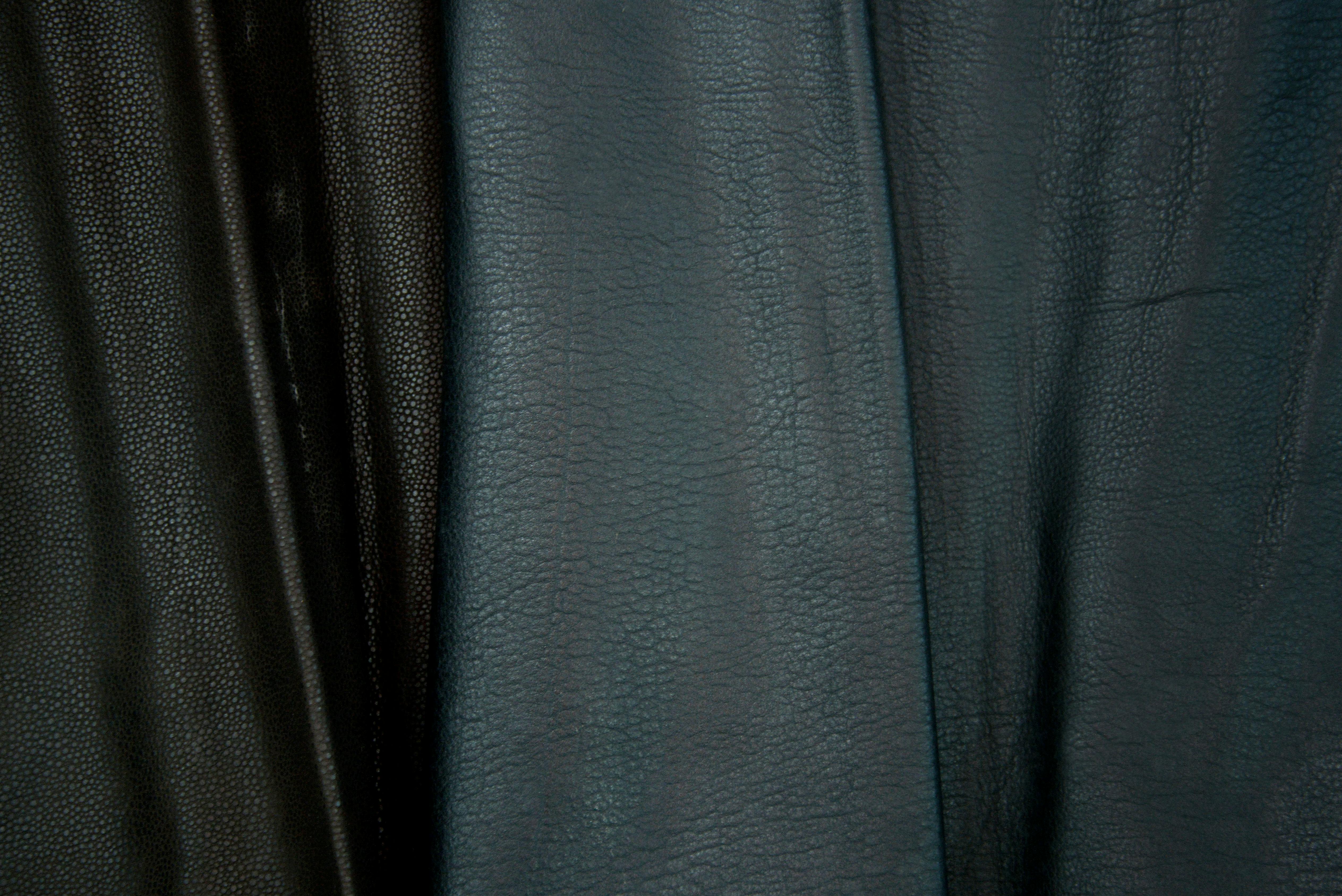
Substantial and soft at once is how authentic hide reads at this level, which is difficult to fake. Take the bag under a lamp: real leather soaks it up rather than returning a sheen. Natural, irregular grain is what you want, never a uniform repeat, and never unnaturally cracked. Stiff, thin or faintly plasticky is the counterfeit signature, and it reflects light like something coated. If the bag is suede, expect uniform colour and no plastic sheen, since patchy colour and shine each count as a tell. Because the camera flattens this quality, touch beats sight on this one.
4. Find Both Stamps, Then Judge Them
A genuine bag carries two marks, both deliberately understated. Small and low on the side is correct for the exterior stamp, blending into the leather rather than announcing itself. Inside, the stamp should be crisp and centred, reading the logo along with the words Made in Italy, which the brand lists on its own product pages for the Half Moon, Soft Margaux 10 and 12, Margaux Shoulder 12, Bourse Clutch, Terrasse To-Go and Large Slouchy Banana. Treat misaligned letters, smudged edges, uneven depth and off-centre placement as red flags. A large or prominent exterior mark is wrong for this label as a matter of principle, because nothing in the design language allows for it. Assess how well the impression is struck, not simply that it exists.
5. Hardware: Feel It, Then Work It
Genuine hardware is palladium-plated, matte or brushed, never mirror-bright. It should feel solid rather than hollow, showing smooth edges and no casting seams. Cycle each closure a number of times, since the action should be precise and repeatable rather than loose or gritty. Engraving appears on the Margaux buckles and base feet, and its quality is a useful thing to test in close-up. The Soft Margaux family adds protective metal feet and an interior toggle closure, so a listing missing either detail deserves questions. Few things disqualify a row handbags listing faster than shiny, lightweight or roughly finished fittings.
6. Empty the Bag and Watch It Stand
Because shape is a product of how a bag is built, counterfeits rarely reproduce it. Empty, a genuine bag holds its shape, and it recovers its form once it has been carried. Empty the bag, place it on something flat, and look from the side — not from above. Where the leather is thinner you get slumping, collapsed corners and a base that will not sit flat. Where published figures exist, use them: the Soft Margaux 10 appears at 10 x 7 x 7.5 inches with a five-inch handle drop. Take care with the Half Moon, where the official 8 x 13.5 x 2.5 inches conflicts with figures published elsewhere, so small variance should be treated as inconclusive.
7. Name It Model by Model, Not Brand-Wide
Price checks hold up, but only model by model, never across the whole brand. A leading resale authenticator sets new Margaux bags at the $5,000 to $9,000 mark, and the Margaux 15 has been reported reselling at roughly $4,350 to $6,000 and above in early 2026, so a listing in the hundreds is almost certainly counterfeit. Resist applying it line-wide: on observed 2026 prices, genuine catalogue pieces exist at $590 for the Double Travel Wallet, $900 for the Boone Tote and $1,390 for the Half Moon. Because invented model names are common on counterfeit listings, verify the name against the real line as well. Anything outside the N/S Park Tote, Park Tote, Park Tote Three, XL Park Tote and N/S Park Crossbody is not part of the Park family. Reports in 2025 widely described the Margaux as pulled from third-party retailers, though the brand has never officially confirmed it, and that scarcity raises the stakes.
The Box and the Dust Bag: Supporting Evidence Only
Dust bags and boxes deserve a look, but neither one can carry the decision by itself. On an authentic dust bag a branded ribbon is stitched into one bottom corner, a care card normally comes with it, and box logos are centred, with the spacing even. Counterfeiters replicate packaging far more readily than edge paint, and boxes and dust bags can be sourced on their own and matched to a fake. Correct packaging supports the case, and incorrect packaging is a reason to go back over the bag more carefully. Treat receipts and screenshots with the same scepticism, because faking them takes almost no effort. Fail checks one through six and no dust bag can rescue the bag.
Where to Buy, and What to Check First
Where you buy matters as much as what you check, precisely because in-hand inspection is the only reliable method. Purchase new from the brand’s own boutiques or from established stockists such as Bergdorf Goodman, Neiman Marcus, Net-a-Porter, Mytheresa or Selfridges and the question disappears. Rebag, The RealReal, Fashionphile and Vestiaire Collective authenticate in hand, and that puts them at lower risk than open marketplaces. Poshmark and eBay are flagged in counterfeit reporting as higher-risk venues for this label, which leaves the burden with the buyer. Before any money moves, run the sequence below. The table below shows each checkpoint in pass and fail form.
- Confirm the model name exists and price-check it against that model, not the brand
- Go over the stitching density and edge paint in hand or in close-up images
- Read the leather or suede for feel, grain and the way it takes light
- Locate both stamps and assess the interior one for crispness and centring
- Check the hardware for weight, finish and closure action, plus Margaux engraving quality
- Take everything out and see whether it stands and keeps its shape
- Treat packaging as corroboration only, and buy through an authenticating source
| What to Check | Good sign | Warning sign |
|---|---|---|
| Stitching | Density holds steady, nothing frayed | Drifting stitch lines, threads working loose |
| Edge finish | Applied evenly, with no overflow | Bubbling, or coverage gone thin |
| Leather | Absorbs light, substantial yet soft | Stiff, thin or faintly plasticky, reflective |
| Suede nap | Even in colour and matte from end to end | Patchiness, or a sheen that reads as plastic |
| Exterior stamp | Sits low, reads small | Oversized, set high, or too prominent |
| The stamp inside | Crisp, centred, logo plus Made in Italy | Smudged, misaligned or off-centre |
| Hardware | Solid, matte or brushed, with a precise action | Light and mirror-bright, rough or gritty in action |
| Structure | Holds itself up empty, recovers its form | Collapsed corners, a slump, an uneven base |